
Stainless Steel Machining Services: Grades, Passivation, and the Material Record That Proves Them
Stainless steel machining services sell corrosion resistance, but corrosion resistance is a property that cannot be seen on a dimension report, which makes stainless the material where the traceability chain earns its keep. The grade decides how the metal behaves in service, the machining decides whether it keeps that behavior, and passivation decides whether the surface you paid for actually exists when the part ships. Every one of those steps belongs in the lot record, from the XRF check at receiving to the passivation certificate at the end. This guide takes the buyer's view of stainless machining as a material-record problem: which grade to specify, what machining does to the metal, what passivation really does, and which questions expose a shop that cannot prove what it shipped.
Which stainless grade should your drawing specify, and why does the record have to prove it?
Stainless steel is a family defined by a minimum of roughly 10.5% chromium, which forms the self-healing chromium-oxide film behind the metal's name. Beyond that, grade choice is an engineering decision about strength, corrosion resistance, machinability, magnetism, and price, and the differences are invisible on a machined part. Four grades carry most CNC work:
- 304 (and 304L) — the default stainless. Good strength, excellent formability and weldability, and the lowest cost of the common grades: food equipment, enclosures, brackets, fasteners, general corrosion service. The L version lowers carbon for welded assemblies — a distinction that matters through sensitization, below.
- 316 (and 316L) — 304 plus molybdenum, which buys a large step up in resistance to chlorides and pitting: marine fittings, coastal hardware, chemical-process components, medical devices that see saline or aggressive cleaning. It costs more and machines a little harder; specify it where the environment demands it.
- 17-4 PH — the precipitation-hardened specialist, machined in the annealed condition and aged (commonly H900 to H1150) to a specified hardness and strength approaching alloy steel. Aerospace fittings, valve and pump shafts, high-strength structural parts. The condition is a specification: the drawing must name it, and the record must prove the finished part is in it.
- 440C — the high-carbon martensitic grade that heat-treats to 58–62 HRC, machined annealed and hardened afterward for wear surfaces: bearings, cutlery, valve components, molds.
Two families sit behind these grades. The austenitic 300-series are the corrosion workhorses — essentially non-magnetic, ductile, and prone to work-hardening under the tool. The hardenable grades are the strength and wear specialists. A drawing that says "stainless" without a grade and condition leaves the most important material decision to the supplier, and a record that cannot name the grade is a record that proves nothing.
Why is stainless harder to machine, and what does machining do to the material?
The machining difference between stainless and aluminum is a regime change, not a matter of degree. Austenitic stainless work-hardens under the cutting edge, galls against tooling, and conducts heat poorly — the heat stays in the tool instead of leaving with the chip. The practical results are slower cutting speeds, shorter tool life, and a requirement for rigid setups and positive-feed cutting: a tool that rubs instead of cuts hardens the surface it is supposed to be machining. This is why a stainless part costs more than the same geometry in aluminum even before material is priced.
For the buyer, two consequences deserve attention. The first is cost: a quote for a thin-wall stainless part at aluminum cycle times is a quote that has not thought about the job — either the tools burn or the surface degrades. The second is surface integrity: machining leaves a thin, disturbed layer on austenitic stainless that can carry embedded tool material — iron from the tooling, for example, which then rusts and defeats the point of stainless. This is exactly why passivation exists and why it belongs in the record on corrosion-service parts. A shop that discusses chip load, coolant strategy, and tool geometry when quoting stainless is a shop that has machined it; one that quotes it like aluminum has not.
What is sensitization, and when does the "L" grade belong in the record?
One stainless failure mode is invisible at delivery and appears only in service, and it is the reason the L in 304L and 316L exists. When austenitic stainless is held in the 425–870 °C range — which is exactly what happens in the heat-affected zone of a weld — chromium carbides precipitate at the grain boundaries, depleting the chromium next to them. The metal is no longer uniformly "stainless": it corrodes preferentially at the boundaries, a failure called sensitization or weld decay.
The fix is a low-carbon grade. 304L and 316L cap the carbon so the precipitation cannot deplete enough chromium to matter, and they are the standard choice for welded assemblies. Two buying rules follow, and both belong on the record:
- If the part is welded — even a small welded detail — specify the L grade. The price difference is small; the service-life difference can be decades. The record should show the L grade was ordered, received, and machined.
- If the part is machined only and never welded, the standard grade is fine. Machining does not reach sensitization temperatures, so 304 is correct for a purely machined bracket, and the L grade adds cost without benefit.
This distinction — weldable versus machined-only — is exactly the kind of specification a buyer should settle early, because it is invisible in a machined part's appearance and expensive to discover in the field.
What does passivation do, and why must it be in the record?
Passivation is the most misunderstood step in stainless finishing, so precision helps. It is not a coating and it adds nothing to the surface. Passivation removes free iron and other surface contamination left by machining — embedded tool particles, shop dirt — and allows the chromium-oxide film to form uniformly. The result is that the part's real corrosion resistance, which machining compromised, is restored. The reference standard is ASTM A967, and it is specified by name rather than by the vague "passivate."
When does passivation matter? Whenever the part must actually resist corrosion in service: medical devices, food contact, marine hardware, chemical handling. A machined 316 part that skips passivation can show rust spots where embedded iron oxidizes, not because the stainless is bad, but because the surface was contaminated during machining. On a traceable order, the passivation step is recorded: who did it, to which standard, on which lot, with what verification (typically a free-iron or corrosion test). A record that ends at the machine and restarts at the passivator has a gap exactly where the corrosion resistance is restored.
One caution belongs in the specification conversation: passivation is only meaningful on grades that form a passive film — the austenitic 300-series and the precipitation-hardened grades in their aged condition. Free-machining grades with added sulfur (303, for example) passivate less well because the sulfur inclusions break up the film; they are chosen where machinability matters more than maximum corrosion resistance. If your application is truly corrosive, the grade and the passivation decision are made together, not separately.
What does the material record look like on a traceable stainless order?
The traceability chain for a stainless part has the same four links as any precision metal, and each one matters more because the properties are invisible:
- The mill certificate names the grade, condition, and heat or lot identity. For 17-4 PH the condition matters as much as the grade — annealed and aged H900 are different materials.
- The receiving check — an XRF spectrometer reading at intake confirms the elemental fingerprint, including the molybdenum that distinguishes 316 from 304 and the chromium that makes any of it stainless at all. This is the check that catches a substituted or mislabeled bar before it is cut.
- The machining and heat-treat record — which lot, which machine, which batch, and — for hardened grades — the heat-treatment record with hardness verification after aging. The difference between annealed and aged 17-4 PH is roughly a doubling of strength; it is a specification, and the record must prove which one shipped.
- The finishing record — passivation to a named standard, with the certificate flowing back into the lot file, plus dimensional reports for critical features measured on CMMs.
The test of a complete record: can the supplier show that the certificate, the XRF check, the heat-treat record, and the passivation certificate describe the same part, same lot, same revision? Stainless is where grade substitution hurts most, because the difference between 304 and 316 — or 304 and 303 — is invisible on a dimension report and fatal in the right environment. The record is the only defense that travels with the part.
What tolerances and finishes can a stainless machining service hold, and record?
Milled and turned stainless features are held to ±0.003 mm, with precision-ground features reaching ±0.002 mm, and on key characteristics the process is charted to Cpk ≥ 1.851 where the lot is representative, above the key-characteristic standard of Ppk ≥ 1.67 initial and the general standard of Cpk ≥ 1.33. Stainless does not fight dimensional control the way it fights tool life; the tolerance capability is there.
Read the tolerance band before you read the index. Cpk is a ratio of the tolerance band to the process spread, not an absolute measure of accuracy. The figure above was recorded on a length characteristic with a 0.4 mm band (76.1–76.5 mm) — wide by design. Hold the same process spread against a ±0.005 mm feature and it fails outright. Ask for the band, the subgroup count and the sampling window on every capability number a supplier quotes.
Surface finish on stainless serves both function and cleanability, and the callouts need method and cutoff to be recordable. Functional surfaces that must resist corrosion should be finished and then passivated, not machined and shipped. For appearance, stainless offers what aluminum does not: a clean machined finish, bead blasting for a uniform matte surface, brushing or satin finishes, electropolishing for a bright, smooth, easy-to-clean surface, and black oxide for a dark non-reflective finish. What stainless does not do is anodize, that is an aluminum-specific process, and a request to "anodize" a stainless part tells the supplier the drawing was written from an aluminum template.
What should you ask before sending stainless work to a machining service?
Stainless rewards verification more than most metals because its selling point — corrosion resistance — is invisible to inspection. A practical screen:
- What happens at material intake? The answer should name an XRF spectrometer check against the mill certificate, recorded per lot — the check that distinguishes 316 from 304 by its molybdenum, and confirms the grade before the bar is cut.
- How is the condition verified on hardened grades? If the drawing calls 17-4 PH H900 or 440C at a hardness range, the supplier should show hardness verification after heat treatment, not just the heat-treat vendor's word.
- Who does the passivation, and to what standard? A967 is the reference. Ask how the coating-free passivation is verified on the lot — the answer should name a test, not an intention.
- How are tight features measured, and at what temperature? Named CMMs, measured values against the drawing, and a stated reference temperature mark a real dimensional record.
- How is the lot tied to the parts? Can the supplier show the certificate, XRF record, heat-treat record, and passivation certificate for one finished order, all describing the same lot? The answer should be a document trail, not a promise.
- What ships with the parts? The material certificate with XRF verification, the dimensional report, and the finishing certificates should travel with the order automatically.
Send these questions by email before you send a drawing. A shop that answers with instrument names, standard numbers, and record structures is running the chain your part depends on; one that answers with assurances is asking you to accept corrosion risk on its behalf.
Frequently Asked Questions
Which stainless steel grades do your machining services run?
304, 304L, 316, 316L, 17-4 PH, and 440C are the regulars, with 303 and 416 for free-machining applications. Every incoming lot is XRF-checked against its mill certificate — including the molybdenum that distinguishes 316 from 304 — and the verification is part of the lot record.
What tolerances can you hold on stainless steel parts?
Milled and turned features to ±0.003 mm, with precision-ground features to ±0.002 mm. On a representative length characteristic of 76.1–76.5 mm, the process holds Cpk = 1.851, above the key-characteristic standard of Ppk ≥ 1.67 initial and the general standard of Cpk ≥ 1.33.
Can stainless steel parts be anodized?
No — anodizing is an aluminum-specific process and stainless does not form that type of oxide coating. For stainless, specify passivation to ASTM A967 to restore the corrosion-resistant surface after machining, or electropolishing, bead blasting, brushing, or black oxide for appearance.
Should I specify 304 or 304L, and 316 or 316L?
If the part will be welded, specify the L grade: low-carbon 304L or 316L prevents sensitization — chromium-carbide precipitation in the weld heat-affected zone — which causes localized corrosion in service. For a machined-only part that never sees welding temperatures, the standard grade is correct and slightly cheaper.
Can you machine a single stainless prototype before production?
Yes — MOQ is one piece, and prototypes run on the same machines, tolerances, and record-keeping as production, so the part and its documentation you validate are the ones we produce.
What documentation ships with a stainless machining order?
Material certificates with XRF verification records, heat-treatment and hardness records for hardened grades, CMM dimensional reports for critical features, and passivation certificates where specified — all tied to the same lot and revision, as part of the order rather than an extra.
Which certifications does the shop hold?
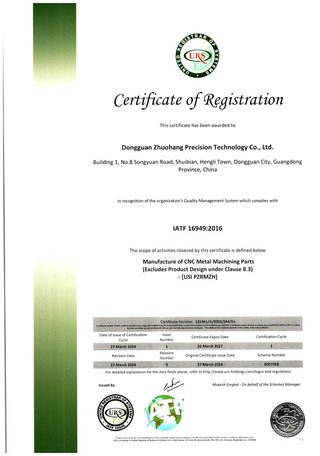
ISO 9001:2015, IATF 16949:2016, and ISO 14001:2015 — with the IATF scope excluding product design under Clause 8.3, as a build-to-print manufacturer. Send a drawing to [email protected] and the traceability record comes with the quote and the parts.