
Titanium Machining Services: Grades, Cost Physics, and the Lot Record a Premium Metal Demands
Titanium machining services supply the parts that must keep working where aluminum softens and steel is too heavy: aerospace structure near heat, implants inside the body, marine hardware in salt water, motorsport components priced by the gram. The metal earns every part of its reputation — expensive, slow to cut, unforgiving of shortcuts — but the cost is predictable once a buyer understands it. What is not predictable is the grade on the certificate, which is why titanium is the metal where material verification matters most.
How do titanium grades divide, and which one belongs on your drawing?
Titanium buyers face a specification decision that has no equivalent in aluminum work, because the grade families differ by microstructure as much as by strength. For CNC parts, the practical map looks like this:
- Ti-6Al-4V (Grade 5) — the default for high-strength machined parts. Its strength advantage over commercially pure titanium is roughly threefold, which is why aerospace brackets, motorsport components, and load-bearing mechanical hardware specify it. Typical published ultimate tensile strength sits near 950 MPa, with a minimum around 895 MPa. A drawing that says "titanium" alone will be quoted as Grade 5 by most shops — write it down so the certificate can match it.
- Grade 2 commercially pure — the corrosion-first choice. It trades strength (roughly 345 MPa typical UTS) for formability and resistance, and it is specified where the environment is the enemy rather than the load: chemical-process fittings, marine hardware, heat exchangers, surgical instruments. It also machines more easily than Grade 5, which matters on high-volume corrosion parts.
- Grade 23 (Ti-6Al-4V ELI) — the implant grade. Extra-low interstitial control of oxygen and other elements buys fracture toughness and ductility, which is what load-bearing medical devices need. It machines like Grade 5 and carries a premium for its tighter specification.
The decision rule for a buyer: let the application pick the grade — load at temperature points to Grade 5, a corrosive environment points to Grade 2, a load-bearing implant points to Grade 23 — then put the full designation on the drawing so the shop quotes the metal you designed, not the one it happens to stock.
What makes titanium so expensive to machine, and how should the quote reflect it?
Titanium's machining cost is not a premium anyone chooses to add; it follows from three physical facts that no tooling or technique can fully escape:
- Heat has nowhere to go. Titanium's thermal conductivity runs only about 6–7 W/m·K — roughly a tenth of aluminum's — so the cutting heat that other metals sweep away in the chip stays concentrated at the tool tip. The only safe response is to cut slowly, which stretches every cycle time and pushes up the machine-hour content of the part.
- The metal reacts with the tool at cutting temperature. Titanium welds itself to a dull edge, forming a built-up edge and galling, and a tool that rubs rather than shears hardens the surface it is cutting. The workaround is sharp, coated carbide or specialized tooling, positive-feed parameters, and flood coolant delivered where the cut happens — equipment and discipline that cost money and show up in the quote.
- Thin sections spring back. Titanium's low stiffness means slender features deflect under tool pressure, so holding a tight tolerance on a thin wall is a fixturing and toolpath problem rather than a simple machine-accuracy question.
Read any titanium quote against those three facts. A price that looks like aluminum rates is not a bargain; it is a sign the shop has not felt the tool burn yet. The honest quote runs slower, spends more on tooling, and says so, and it is the only kind of quote that delivers a titanium part with its surface integrity intact.
The material bill sits on top of the machining reality, and it is worth separating the two when you compare quotes. Titanium stock costs many times more than aluminum per kilogram, and the premium grows with grade, form, and traceability — certified aerospace stock with full documentation carries a meaningful uplift over commercial bar. A quote that bundles material and machining into one number hides which part of the price is physics and which is the metal itself; a quote that shows the material line separately lets you see both, and lets you act on the one lever you actually control — the grade decision. If the application can use Grade 2, it should; if it needs Grade 5, the price of the stock is the price of the property.
What tolerances and finishes can a titanium machining service hold, and record?
Milled and turned titanium features are held to ±0.003 mm, and precision-ground features — bearing seats, seal faces, critical diameters — reach ±0.002 mm. On key characteristics the process is charted to Cpk ≥ 1.851 where the lot is representative, above the key-characteristic standard of Ppk ≥ 1.67 initial and the general standard of Cpk ≥ 1.33. Titanium's dimensional behavior is stable once heat and deflection are managed; the risk lives in the machining, not the metal.
Read the tolerance band before you read the index. Cpk is a ratio of the tolerance band to the process spread, not an absolute measure of accuracy. The figure above was recorded on a length characteristic with a 0.4 mm band (76.1–76.5 mm) — wide by design. Hold the same process spread against a ±0.005 mm feature and it fails outright. Ask for the band, the subgroup count and the sampling window on every capability number a supplier quotes.
Surface quality on titanium carries a consequence that does not exist on aluminum: a damaged, re-hardened surface layer. Because titanium work-hardens and burns easily, wrong cutting parameters leave a disturbed layer that acts as a crack-initiation site on fatigue-loaded parts. The prevention is process discipline — coolant delivery, fresh inserts, finishing passes that remove the disturbed layer — and it should be part of the supplier's answer before you ask. On the finishing side, titanium anodizing is a thin, voltage-controlled oxide film that produces interference colors for identification or appearance; there is no thick hardcoat equivalent to aluminum's Type III. Bead blasting, polishing, PVD or DLC coatings, and passivation cover the practical finish range, and a drawing that asks for "hard anodize" on titanium was written for the wrong metal.
When is the titanium premium justified, and when is it a waste?
The premium buys specific properties, and it pays only when the design actually uses them. Four situations make titanium the engineering answer rather than an indulgence:
- The part runs hot. Aluminum loses strength progressively above roughly 150–200 °C, while titanium holds useful strength far beyond that boundary, so engine-adjacent brackets, exhaust hardware, and heat-affected structures have no lighter alternative.
- The environment defeats every coating. In marine immersion, hot chlorides, and chemical service, aluminum pits and coated steel eventually fails at the coating. Titanium's oxide film is self-healing, which is why Grade 2 is the specification when nothing plated or painted is good enough.
- The body must accept it. Titanium's biocompatibility record makes Grade 5 and Grade 23 the reference for surgical instruments and implants; no coated substitute carries the same history.
- Weight is priced like a commodity. In aerospace and motorsport, every saved kilogram has a value, and titanium's strength-to-weight ratio buys that value where the arithmetic works.
The boundary case deserves equal honesty: a room-temperature part in a benign environment that is not weight-critical gets nothing from titanium that an anodized aluminum part or a coated steel part cannot deliver for less. A supplier that raises that point is engineering your cost; one that quotes titanium without asking about the environment is not.
What must the lot record prove on a titanium order?
Titanium is where material provenance stops being paperwork and becomes the product, because the stock is expensive enough to tempt substitution and the applications — aerospace, medical — demand traceability that cannot be reconstructed later. A complete record has four links, and a buyer should be able to see all of them:
- The mill certificate names the grade, condition, and heat or lot identity — Grade 5 differs from Grade 2 by its alloying content, so the designation on the certificate is the claim the whole chain rests on.
- The receiving check verifies that claim: an XRF spectrometer reading at intake compares the lot's elemental fingerprint — the aluminum and vanadium that make Grade 5 — against the certificate, catching a mislabeled bar before it is cut rather than after a part fails.
- The machining record ties that verified lot to specific machines, batches, and parts, so any later failure can be walked back to its material and process.
- The finishing record closes the loop on subcontracted steps — anodizing, passivation, PVD or DLC — with certificates that flow back into the lot file instead of leaving a gap where the surface was changed.
The completeness test is simple: can the supplier show certificate, XRF record, machining batch, and finishing certificates describing the same part, same lot, same revision? For titanium in aerospace and medical service, that chain is not an administrative extra — it is the difference between a controlled system and a folder of documents that prove nothing.
What should you verify about a titanium machining service before sending work?
Because titanium punishes both price mistakes and process mistakes, the pre-order screen earns its keep. Six questions, answered by email before geometry ships:
- How is incoming material checked? The answer should describe an XRF verification against the mill certificate, recorded per lot — the check that proves the grade before the first cut. Anything vaguer is a promise, not a control.
- Which grade does your quote assume, and is it on the certificate? The quote and the material record should name the same designation your drawing carries.
- How is heat managed in the cut? Coolant delivery, cutting parameters, and tooling policy should be specific — high-pressure coolant, sharp coated inserts, controlled chip load. Vague answers mean the shop has not machined much titanium.
- How is surface integrity protected on fatigue-critical parts? The answer should name finishing passes and fresh tooling that remove the disturbed layer, not assurances about quality.
- Who does the finishing, and how does it return to the record? Anodizing, passivation, and coatings are usually subcontracted; the supplier should name the vendors and show how their certificates rejoin the lot file.
- How are tight features measured? Named CMMs, measured values against the drawing, and a stated reference temperature — 20 °C per ISO 1 — mark a dimensional record that means something.
On titanium, the gap between a shop that machines the metal properly and one that machines it cheaply is invisible in the price and visible in burned tooling, re-hardened surfaces, and failed parts. The supplier's process is the specification; verify it before you commit geometry.
Frequently Asked Questions
Which titanium grades do your machining services run?
Ti-6Al-4V (Grade 5), Grade 2 commercially pure, and Grade 23 (Ti-6Al-4V ELI) are the regulars, with every incoming lot verified against its mill certificate by XRF elemental analysis at receiving — the check that distinguishes the grades before the bar is cut.
What tolerances can you hold on titanium parts?
Milled and turned features to ±0.003 mm, with precision-ground features to ±0.002 mm. On a representative length characteristic of 76.1–76.5 mm, the process holds Cpk = 1.851, above the key-characteristic standard of Ppk ≥ 1.67 initial and the general standard of Cpk ≥ 1.33.
Can titanium be hard-anodized like aluminum?
No — titanium anodizing produces a thin, voltage-controlled oxide film that creates interference colors for identification or appearance, with no thick hardcoat equivalent to aluminum Type III. Bead blasting, polishing, PVD or DLC coatings, and passivation are the practical finishing options.
Why does titanium machining cost more than aluminum or stainless?
Three physics facts drive it: titanium conducts heat poorly, so cutting must be slow; it reacts with the tool and work-hardens, so tooling costs more and must be managed; and its low stiffness complicates thin-wall work. Material cost sits on top of those machining realities.
Can you machine a single titanium prototype before production?
Yes — MOQ is one piece, and prototypes run on the same machines, tolerances, and record-keeping as production, so the part and its documentation you validate are the ones we produce.
What documentation ships with a titanium machining order?
Material certificates with XRF verification records, CMM dimensional reports for critical features, and finishing certificates where anodizing, passivation, or coating is specified — all tied to the same lot and revision, as part of the order rather than an extra.
Which certifications does the shop hold?
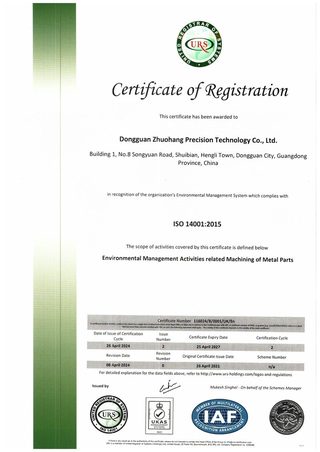
ISO 9001:2015, IATF 16949:2016, and ISO 14001:2015 — with the IATF scope excluding product design under Clause 8.3, as a build-to-print manufacturer. Send a drawing to [email protected] and the traceability record comes with the quote and the parts.